
NADI Billing — ISP Operating Platform
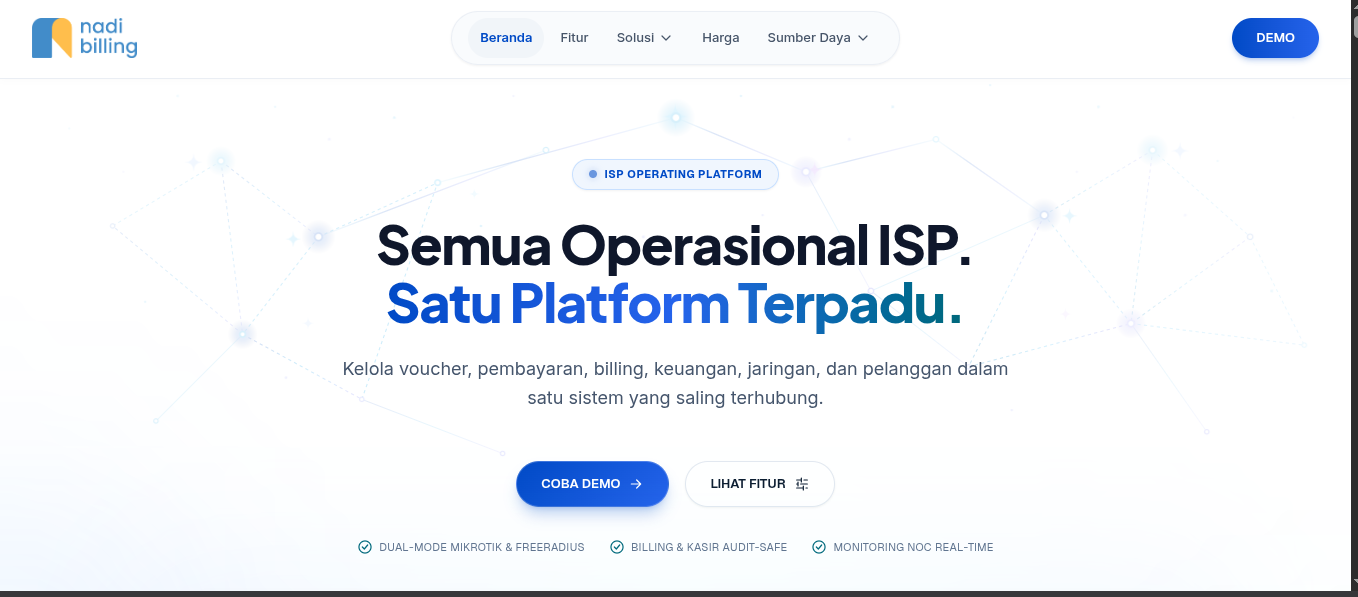
NADI Billing is a marketing and product-exploration website for an ISP business management SaaS platform.
The platform is designed to help small and medium-sized internet service providers—including RT/RW Net operators, Mini ISPs, FTTH providers, and hotspot businesses—manage customers, billing, vouchers, network infrastructure, reseller operations, and customer service from a unified system.
This repository is the marketing website rather than the complete operational backend. Its main purpose is to present product features, operational workflows, and integrations through a responsive, structured, and interactive web experience.
Business Processes
1. ISP Customer Registration
A sales or customer-service representative records a potential customer.
The location and network topology are surveyed.
The prospect enters the CRM pipeline.
The customer is activated after installation and assigned a service package.
Invoices and network information become part of the customer record.
2. Monthly Billing
The system generates customer invoices according to the configured billing cycle.
Payments are recorded through the cashier or reseller portal.
Payment records are reconciliated against operational cash-flow reports.
Every sensitive payment action is stored in an audit log.
3. Hotspot Voucher Sales
The operator chooses a voucher package and quantity.
The system generates up to 500 unique vouchers.
Vouchers can be printed using A4 or thermal printer layouts.
Operators distribute vouchers directly or through reseller agents.
Voucher sales and commissions are tracked through the reporting system.
4. Network Fault Management
The system monitors router and fiber-network telemetry.
Optical degradation patterns are analyzed.
The fault engine identifies a probable issue level:
Single-customer dropcore failure
ODP or distribution cable failure
Cascading upstream or ODC failure
A technician task or customer ticket is created automatically.
Detection and recovery times can be measured through MTTD and MTTR reports.
5. Customer Self-Service
Customers can access a dedicated portal to view billing information, submit support requests, manage Wi-Fi settings, and perform supported modem actions.
6. Reseller Operations
Resellers can:
Manage voucher inventory
Use deposited wallet balances
Sell vouchers or process customer payments
Track commissions
View sales reports
Project Initiation
Objective
The project was initiated to present a complex ISP operating platform through a clear and accessible website.
The main goals were to:
Explain the operational problems faced by ISP businesses.
Demonstrate the connection between billing, network management, and customer service.
Present product modules and real-world workflows.
Provide interactive demonstrations instead of static feature descriptions.
Maintain consistency between marketing content and documented feature status.
Target Users
RT/RW Net operators
Mini ISP owners
FTTH network operators
NOC and network administrators
Finance and cashier teams
Customer-support teams
Field technicians
Reseller and agent networks
End-customer internet subscribers
Technical Approach
The website was built with a reusable component architecture:
src/app— routes, layouts, and page metadatasrc/components/sections— homepage marketing sectionssrc/components/marketing— demonstrations and product previewssrc/components/layout— navigation and footersrc/components/ui— reusable interface elementssrc/data— marketing copy, demo flows, documentation, and navigationsrc/lib— metadata and public-origin utilitiessrc/types— shared TypeScript definitionsdesign/stitch— visual design referencestests— Playwright end-to-end tests
Server Components provide the default rendering model. React state is used only where interaction is required, such as navigation menus, flow simulators, category filters, and dynamic calculators.
Several advanced product capabilities described in the documentation—such as payment gateways, real WhatsApp/SMS delivery, automatic voucher activation, and 2FA—are still marked as planned or partial. These should be presented as product roadmap items rather than active capabilities.
The /demo interface is also explicitly identified as a local workflow simulation. It does not process real payments, send real messages, or access live customer data.